Showing posts with label Your Say. Show all posts

Friday, May 19, 2017

A naive engagement towards personal action


"You make me wanna die"
"Make Me Wanna Die" - The Pretty Reckless

I have a huge problem: when I hear about what happens in the world, or even what happened in my country in the past, the implications of the happenings being spoken about get stuck in my head. It depresses me, and can chase me for days before the emotional response it creates in me goes away. For that time, I can almost only dream about that, mostly about me changing things. It's really hard for me to convince myself that, at least for now, there's nothing I can do about it, and that the most effective thing I'm to do is relaxing and stop concerning myself in such a way.

Sometimes I wish I hadn't read anything. If I didn't know the things I know and didn't have the convictions I have, I could still live that unconcerned life I lived when all I did was drawing furries and writing stories about them on Wattpad. Life was artistical, sexual, musical, colorful back then, and it didn't involve Kurdish people being bombed by the fascist government in Turkey: it was a blind, self-focused imaginative life, and it was perfect. Wanting to go back to it, though, seems like a disposal of responsibility; nothing is going to be done if nobody cares in the first place.

But I do feel impotent either way. I know there must be something that can be done to induce action by those who can actually have a determining role on the situation, but I don't know what to do. I must keep in mind that I'm underage and unknowing of any association or group with this objective, so there might really be nothing I can do now, apart from trying my best to raise awareness. I know the perfect engagement on this is calmness, keeping oneself together and, without getting obsessed or depressed about the subject, trying one's best to help the cause, but probably I still need a lot of thought to give myself in order to reach it.

I do want to live naively, and I do want to go back to being able to see life the way it was. I do want to help, and I do want to be part of the solution, but I also want my life back. I know it's my mindset that is wrong, but it seems so hard to change or get rid of...

How art creates the artist


"You're the creation,
You're the reason,
You're the rising sun,
And the colours in my mind."
"Creation" - The Pierces
I like to say we all have an untamable and violent beast inside us, it kicks us and crashes us until we let it have its freedom, and we can only set it free for a little while, whether its in a drawing, in a song, or in a writing. It's the desperate need for self-expression.

It's only when we let that vicious monster out of us, that we feel that we are building ourselves, that we are getting to count somehow, leaving a mark, a proof that we've been there. When something horrid and morbidly amorphous has come from the most obscure spot of our being and has reached an audience in the shape of a beautiful creation.

And it's that terrible reflection of us, left for ourselves to see in everything we do, that makes us somehow. We see this when we realise the character we created for a story is just a slightly modified version of what we could never avoid being, when we become words or lines on a paper drawn by an illusory and unreal creation of our imagination, then, is when we're created.

We're never truly born until we're made, and only our imagination can make us.

Friday, March 17, 2017

Tollerance, voltaire and K. Popper [part III]


"But you,
You can do better than that."
"Better Than That" - Marina And The Diamonds

That author was Karl Popper. Mostly known for his theories on science and its development, as well as for his rivality with the Vienna Circle, he proposed a rational correction to Voltaire's postullate of absolute tollerance based on empyrical observation: he added to it the logical premise implying that tollerance towards intollerant views would put that same tollerance in danger. Or, in other words, if, in twenty years, we let that man called Adolf Hitler speak and freely win the ellections in his country, we may be messing up big time.

That way, Popper got to the conclusion that, in order to protect tollerance, some views threatening it must be deprived of it: tollerance should not be applied to attacks against it. That brought an authoritarian but also clarifying turn to the debate: from then on, the absolute tollerance paradigm proposed by Voltaire did not seem so inherent, and a further analysis of what should be allowed and what shouldn't replaced it.

Some say complete tollerance does not work because people are not mature enough to actually take their own decisions. Then another debate should be on whether or not defining maturity over those standards can really be considered tollerance...

That debate, however, does not belong here.

Tollerance, Voltaire and K. Popper [part II]


"You hit me once,
I hit you back,
You gave a kick,
I gave a slap."
"Kiss With A Fist" - Florence + The Machine 

Not even a century after Voltaire's time, Humanity had tollerated the takeover of the ongoing technological progress for the sake of enslaving the majority in a paradigm of exploiters and exploited ones: the magnificent Industrial Revolution had happened, and most people in Europe were starving thanks to it.

At the same time, politics in the Old Continent were filling with tension between nations, with constant attacks between liberal states like France or the United Kingdom and monarchies and imperial states like the newly unified Germany, the Austro-Hungarian Empire or the Ottoman Empire, where regional nationalisms were fiercely persecuted; while this was happening, both sides were accumulating weaponry for an explicitly upcoming war.

It would not be until the early 20th century, in Vienna, when a philosopher would add a bit more sanity to Voltaire's thesis and its effect.

Tollerance, Voltaire and K. Popper [part I]


"Got an opinion,
Yeah, you're well up for slating."
"Everyone's At It" - Lily Allen

The Illustration significated the culmination of three centuries of continuation of ancient philosophy, as well as of continuous and scheme-breaking scientific development, innovation in formal disciplines like maths or logics, retaking of mythological and anthropocentric art and literature... Overall, it was the peak of an impressive intellectual rise in all areas.

Voltaire
One of the topics that Illustrated philosophers spoke about was human freedom and tollerance. From the opposite political thesis of Thomas Hobbes and John Locke to the complete anthropological model presented by Jean-Jaques Rousseau, the limits and preferable ways of human action were spoken about all over the European continent and the United Kingdom, though in separated currents on the two.

The author that interests us is the one who unified both philosophical worlds, who brought the philosophy of Locke and Hume and the science of Newton to the Old Continent: Voltaire. Voltaire's works all revolve around a central thesis, which is based in the total acceptance of all positions in debate; Voltaire, ideologically, became the biggest defender of total tollerance in all areas, ideology, religion, culture...

It would not take all of the centuries passed before that to prove how disasterous the literal applying of his thesis could be.

Thursday, March 16, 2017

In 2013, the best that Europe had to give itself was a song about suicide


"Birds falling down the rooftops,
Out of the sky like raindrops.
Birds falling down the rooftops."
"Birds" - Anouk

The Eurovision Song Contest has had a long and variable evolution over its six decades of existence, and one of its traits that has changed the most over time is its meaning: Eurovision has been a sign of unity in Europe, a folklore showcase, a display of social movements, a space for new musical tendencies and a historical remembrance spot; all in an hours-long yearly music contest.

However, every year –or every now and then– the contest harbours a performance that breaks all those semantic schemes to mean something completely new, strange to the dynamics of the event, and make a short space for something out of the norm. It's usual that those performances fall into oblivion in minutes and remain unnoticed until a couple of years later; this, though, even as an exception itself, has some strange cases.
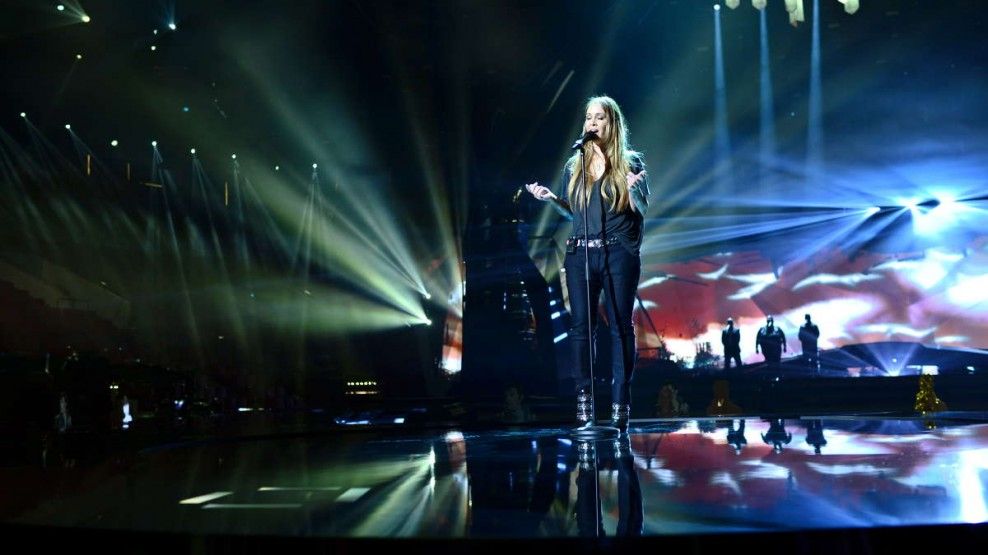
Anouk used an alternative setting for her performance.

One of them, and my favourite, is the case for The Netherlands' song in 2013, "Birds," by Anouk. In an edition, like most, full of love songs, empowering anthems, generic songs and folkloric elements, a song about the consequences of a breakup and subsequent suicidal thoughts, with a beautiful and artistic performance that broke all schemes, even when it came to positioning and use of the staging, rose. It did not win, but it did not remain unnoticed or forgotten either: at that moment, it was impressively striking.

The artist, Anouk, not precisely known for making generic pop songs that could fit an event like Eurovision, chose not to stand on the stage but on the end of the elevated way coming from it that went right into the crowd: that way, with a series of camera cuts, Anouk seemed suspended from the ground and at the same time closely surrounded by the public. The lights, staging and choir, all coming from the stage and filling the performance with an ethereal yet meaningful completion, gave the already magical succession a colorful and heartfelt turn.

For all those reasons, despite the official winner being Denmark, with a generic pop song and a performance filled with folklore, more of a follow-up of what the winner of the previous year had done with "Euphoria," "Birds" is undeniably my favourite song and performance in the 2013 Eurovision Song Contest.

"My soulmate," a task-induced reflection


"You, soft and only,
You, lost and lonely,
You, just like heaven."
"Just Like Heaven" - Katie Melua

For today's task (which somehow counts as a "Your say" writing), linked to our current project about love and relationships, it's required to describe one's ideal soulmate at the moment. To be honest, at first I had no trail of a clue as to how my soulmate should be, but further thought on what I want to do and who I'd want to share my life with has brought some concrete conclusions.

My soulmate should be somebody to collaborate and fight along with, an ally, a comrade. A person of ideas, wiling to change the world for the better and to give their voice and forces to the struggle of the oppressed. I think it would be absolutely impossible for me to share my life with someone who has opposite or unfitting convictions compared to me or no convictions at all.

Another factor to bear in mind is the kind of relationship one can have with a soulmate. If I take the traditional model, with a romantic-sexual relationship in it, the description gets a bit more concrete. I like men: genitals of both sexes are ugly, but I find male anatomy to be, in general, more erotic; that, in return, means I wouldn't care whether we're speaking of a cisgender man or a trans man, and I actually think sharing something like being trans would not only make it that we fight together but also that we have something deep in common.

Furtherly focusing on my sexual likes and romantic needs, though, I think hugging a person who is hard to the touch is just as comforting as hugging the street light next street; my soulmate, in that sense, should be chubby, at least slightly (yes, I ~might~ find chubby men erotic or arousing). I find ripped or only muscular people quite gross, and I think the ideal body type of my soulmate would be big, strong, but also plump and stout; preferably hairy. This, though, is a minor addition compared to the second paragraph.

Most importantly, though, my soulmate must share things with me. What would I do with a rich privileged cis man? How am I going to get him to help me when I fight against his privilege? How can I say to Mr. Bourgeoisie's face that I want to overthrow his class? I can't love someone like that, someone I see as a tyrant and as part of the reason why this world can be such a dark place.

Friday, January 20, 2017

Evolution and Revolution, part II


"My supermodel legs,
They never held up much weight in my world.
My supermodel legs,
'Cause women should be women, girls should be allowed to be girls!"
"Supermodel's Legs" - Marina And The Diamonds

Last week, I wrote about the main reason I considered to be blocking the possibility of a game-changing revolution not only in the Spanish context but worldly. The resulting post was inspired by an article linked at the end of it, and pointed out at the excess of information given to citizens and the lack of time offered to emit a moral judgement towards it as the factors to bear in mind.

However, further introspection has risen new questions about my own thoughts on the topic, and I'm not so sure of what's written there anymore. Taking a look at my own case, I've found myself tending to hide in certain contexts, to the extent, to put a concrete example, of washing my Twitter profile off political symbology –that was meant to represent me and my thoughts– for the sake of springing a good opinion on people I admire or just like, who were going to notice my profile as soon as I liked a tweet of theirs, in fear of them disagreeing.

The issue this brings to my mind is that I'm not the only one who might be hiding content that could lead to people gaining awareness on an issue; that, considering how caring on others' opinions people normally are –not excluding myself–, is a determining factor. On the other hand, it's obvious to me that if a collective susceptible of triggering the revolution we're talking about is not identifiable as part of such, it's unlikely that the so-mentioned group gets to notice its members in order to unionise and make collective action as a result.

This, I consider, is what was left in my latest post. If we got to solve these issues, at least in ourselves, it's likely, though, that we woldn't have done enough to make change active or even possible, but I think we shouldn't underestimate societal factors when what we want is a collective movement to happen.

Saturday, January 7, 2017

Evolution and Revolution


 "A thousand words
Were never spoken
They'll fly to you
They'll carry you home."
"A Thousand Words" - Final Fantasy X-2 Soundtrack

Quite recently, two Syrian journalists found resources from the UK government signed by the NATO in possession of the Islamic State. The resulting news sprung over social media quite fastly until the issue was fully forgotten, days later. The same case, and on the same topic, was given with news regarding a NATO executive who was mysteriously killed while investigating the origin of the wealth of the so-mentioned Islamic State. No western government had to offer any explanation regarding any of the two facts, and both were gone from the collective mind in not much more than a week.

We're constantly being told about horrible things nobody's doing anything about, we were literally told that we're being surveilled as we use the Internet or the telephone; literally, a man called Edward Snowden told us that. We were told, too, about the US arming civil wars in countries like Yemen; literally, a man called Julian Assange told us that. And we're constantly being told about much more terrible issues no government is responding to, because there's no need to as there's no response either way.

We don't even have to go outside this country to find it. Here in Spain, we're constantly being told about corruption cases in the political parties we keep voting. In Autonomous Communities like Valencia votes are traditionally homogeneous in time; in the Valencian case, it's the PP being voted, but in Andalusia it's the PSOE and in Catalonia it's been CiU for so long, and all this time we've been knowing about corruption cases regarding and afeccting those very communities that voted them. Even in the state government we find a whole tendency towards corruption and forgiveness or oblivion, in all the political powers and even in the business and sindicates' areas.

We know, through the information we're given, that our country is stuck in a rotten static system that makes it impossible for Spain to have a heatlhy future, but still that system remains completely undamaged. The largest step taken by the citizens is going into manifestations nobody ever listens to besides those agreeing with it, and that, after the Internet has become the way to raise awareness and unionise the population, does pretty much nothing.

So, inside all of this, why isn't a revolution happening? We know we need it, we know we're trapped in a paradigm where the powerful can even overthrow a foreign government if it doesn't fit their interest, we know nothing is moving by itself and we know nothing is changing if not for worse. Well, the question to lead to that answer must rather be the following: what's the difference between the people who made revolutions and us?

Our world has changed a lot in many different ways, every generation is different from the previous and every time brings a new way to see things. But I think we can all agree that our evolution has been quite linear overall; all this time, we've been moving towards a single direction. We now live in a world where the norm is receiving tons and tons of information of radically different kinds in radically different ways: we watch the news, where they tell us how the UK has admitted that they invaded Libya using lies as a justification and, thirteen seconds later, how an actor took a picture with a famous cat. At the same time this happens, we look at our phones, scrolling through our Twitter timeline, and looking at more countries, more lies, more actors, more cats and even porn in some cases; meanwhile, we might even be listening to music as well, being then conditioned by how the song we're hearing makes us feel, and the list goes on and on.

The thing, then, is that we're stuck, trapped, inside a "tweet culture," where information is reduced to a 140-character-long or maybe a 13-second-long pill to be swallowed right after another radically different one and before even another with a completely different taste. From here on, it's easy to respond to the main question: a revolution isn't happening because we don't have time to think about the information that would cause it in order to have an emotional response, hence, start that revolution. We don't judge the information we're given anymore because we're not given the time to think about it, we then just think in short phrases, tweets, that we didn't even create ourselves but were directly taken from what we were told.

The solution to this is introspection. We know the things we say publicly in the social media are part of that succession of pills and won't be heard or remembered, so the only thing we can change by ourselves is, guess what, ourselves. We need to lose the laziness towards choosing a thousand words in an article rather than a hundred letters in a tweet, we need longer inputs, we need to give more time to the information we're given and to ourselves, we need to silence our phones and focus on one thing at a time, think, valorate, judge, have an emotional response and, from that response, create something new.

But we can't let apathy keep winning.

Original post the idea was taken from [in Spanish]: https://lamentiradelsistema.wordpress.com/2014/01/07/por-que-no-estalla-una-revolucion/, recommended reading for a fully understanding on the topic.

Thursday, November 10, 2016

Religion as a mass control method


"Unless I watch you disappear in to the ground
My one mistake was that I never let you down,
So I'll waste my time
And I'll burn my mind,
I'm Miss Nothing,
I miss everything."
"Miss Nothing" - The Pretty Reckless

Experience leads us to the conclusion that every human being requires, by nature, a system of beliefs, which can range from the firm conviction that there's a spaghetti monster watching over Mankind to the common conception that the existence of the world around us is an absolute truth. Beliefs, though, have a wide variety of origins and natures: some come from philosophic statements from known authors, some are taken as a trait Humanity has had since its very origin, some require certain rites and actions such as praying and some don't imply any specific action taken.

Love it or love it twice, but love it either way.
Once the prior has been stated, it's important to stress on those belief systems that require us to take action in certain ways. In our day and age, we're witnesses of the existence of many generalized belief systems known as religions that share the trait of morally forcing their believers to do so. That obligation, however, doesn't assume the believer will do it for the sake of religious devotion: no, in most* cases, in order to make sure believers follow the established path, religions threaten them with elements like eternal punishment after death or dishonour.

And, once again, it's important to highlight one detail of what has been exposed: in most cases, believers follow the rites and paths of their religion with the sole purpose of avoiding a negative consequence of not doing so; in other words, they do so because they fear what might happen otherwise.

Though this trait major religions of our world share has a very important outcome, it's not what I wish to focus on. On of the things that catch my eye the most is the societal imposition of the beliefs that conform a religion (or, said in a better way, of the fear leading to a certain religion). In an environment where a concrete religion is present (call it a family, a social group, or a intellectually-third-world country), individuals who are yet to form an established opinion and, therefore, are still predisposed to acquire a belief system, are unconsciously forced to, as I call it, "breathe what's in the air," or, in other words, adopt the predominant religion in the context.

Religions are not innate ideas, they are passed from individual to individual in a variety of ways, majorly involving some kind of social imposition or assumption. A pattern that comes up as incredibly useful to exemplify this is the case for sects, where, for the sake of acceptance in a social group, an often extremely delusional belief system, mostly created in recent times with the conscious objective of manipulating a group of individuals, is adopted, often leading to actions such as the transferring of material possessions to the manipulator or even collective suicide rites.

See? Jesus looks the other way.
Leaving that behind, another one of the traits most religions share which captures my attention is the value those religions tend to assign to the believers' actions, whether they are strictly religious acts or not. Most religions assume the objective of our physical life is pleasing a higher entity in order to gain salvation and avoid the punishment I mentioned before. This implies the demotion of Humanity from feeling entities, able to decide what to do and to do it for the sake of themselves and others, to slaves of a deity with no other worth than making God get a boner (sorry for that, I might be getting a bit angry here.)

And, yet again, this leads me to something I've already spoken about: in this case, Humanism. Believing the people around are worthy of love and believing in most religions are not compatible.

The list could go on and on. I know this doesn't do the job as a proof that religions are wrong, but it does prove they are the first thing to get rid of when trying to improve one's own life.

*Whenever the word "most" is used with religions, it has the sole objective of excluding exceptions with almost no representation in our western world like Buddhism. Major religions (Christianity, Islam and Jewism) fall to the definition used to write this post.

Friday, October 21, 2016

Let's talk about #SoyGayYDelPP


"Do you get a little kick out of being slow-minded?"
"F*ck You" - Lily Allen

I've already made my insight on Spanish politics. It isn't a topic I especially want in my blog, but as a person who knows which factors my life and future are driven by, I know the worst I can possibly do for myself is ignoring it.

However, politics as a topic has many spheres and issues to deal about. Political parties are in a constant struggle to convince overevolved monkeys like us that they are relatable from their unrealistic state of apparently sempiternal –until someone grabs a gun– economic privilege, and, for the pursue of that end, they have the need of using certain displays of character with the focus of resembling those outside that privilege state.

One of those desperate attempts to catch the vast minority's attention was the spreading of the Spain-bound epidemic known in social media like Twitter as #SoyGayYDelPP (something like #I'mGayAndIMilitateThePP). And, as to discuss about it, I'd like to analyze what that hashtag says, just the meaning of the words.

We're before a statement of the structure "I'm part of an LGBT collective and of a right-wing party." It's not that it's a common structure in other sentences of the kind, it's just that the structure is important in this case: this could basically translate to "I'm part of a minority and I'm against equality."
Friends of gays, lesbians and social inequality

And, no, the right wing cannot be pro-equality. The right wing is, as an ideology, the defense of a system based on the generation of inequality, at least in the economic plane –also known as Capitalism–, so it is a contradiction to have equality in any sense as a finality and sympathise with the right wing. However, this translated to the LGBT sphere makes yet another twist: we're speaking about a collective of LGBT persons who want not equality for LGBT minorities but individual privilege for themselves: we're not speaking about a mass, or even a minority, we're speaking about a lobby.

And I think by this point we can all recognize where the problem is.

We cannot fight back against people reducing our struggle to "the gay lobby's agenda" when the public eye's grasp is filling with people proving them right: how can I tell a homophobe that gays don't want to have privilege over heterosexuals or even that gays aren't everything inside the LGBT collective when everything that can be seen are gays seeking individual privilege?

This could even link to other problems and issues related to LGBT rights and visibility if overlooked: it perpetuates the stereotyping of the homosexual male while also contributing to the undercategorization and dismissal of other LGBT minorities: we're not speaking about a political party with a stablishing diverse LGBT circle like Podemos or with even a long stablished one and even with transgender visible members and deputies like PSOE, no, we're before the common representation of the gay –rich, white– man as the totality of the LGBT collective, stereotyping and nomalization included. That, though, is another issue.

About engagement and arts online


"Jim told me that
He hit me and it felt like a kiss."
"Ultraviolence" - Lana Del Rey

I'm not an artist, I think calling myself so would be egotistical and excessively self-flattering, but when it comes to artistic disciplines like writing I do consider myself some kind of an initiate: I think I've spoken my mind about why Wattpad isn't exactly the best place to progress as a writer in certain areas, genres or topics, but it's still an adequate place to share and publish written compositions and, if one is lucky, get noticed, receive feedback and get help to improve.

However, this benefit coming from the sharing of one's work with a public audience wouldn't be possible if it wasn't for what that audience does, and that's where problems start. There isn't any inherent obligation for art consumers to contact authors in any way, but I think it's more than demandable that we, as viewers, readers, listeners or whatever, make an effort in order to detect whether or not an author is looking for opinions from us. This is especially important when we're before novice authors in websites that are meant to allow a more or less direct interaction between writers and readers (as is the case between composers and listeners, illustrators and viewers, etcetera) like the so-mentioned webpage or DeviantArt.

This is something I personally do whenever I'm able to: a direct comment section is a good place to point out the good things one likes about what they've seen. If that leads to a private conversation between author and viewer, the last can politely ask if the creator desires further feedback and, if the response is affirmative, then and only then kindly point out what one doesn't like or thinks could be improved, always respecting the author's decision to either change the spoken aspects or not. The point is keeping interaction friendly and constructive. If someone follows these directions while ignoring the principles in bold, they are probably not worth much of our attention.

Either way, this can be done terribly wrong even when trying to be exclusively flattering, and this is when my own experience as a person who writes in Wattpad comes in handy. A story of mine, the title of which I prefer not to reveal in this post, deals about a teenage girl who falls in love with a classmate. At some point of the story, the main character has to charm an older student in order to acomplish her goal, leading this older character to fall in love with her. During a concrete chapter, the protagonist was crying scared because that older student, in a tantrum, had hit her against a wall and caused her to bleed. Over that scene of abuse and defeat, someone kindly commented "This story is so beatiful, I hope they end up together."

At the very moment I read that comment, I ragefully thought of the possibility of the author of it commiting the trascending crime of the romanticizing of gender abuse, though I later got to the conclusion the reader hadn't really read the chapter they were commenting on and just referred to the initial situation, expecting that all the storyline would revolve around the same state.

So, whatever the way, the point of interaction is being nice... but sensible.

Sunday, May 29, 2016

"Mom, why did dad go to war?"


"Where is your heart?
Humanity, rise!
You think you are Gods, hah,
But everyone dies."
"1944" - Jamala

I can't remember the last time I saw in a movie the typical scene where an official or someone of the kind is carrying a country's flag (normally the U.S., because it's obvious other countries are not populated by humans, who dares to say the opposite?) and a fallen soldier's boots for their (I mean, his; these movies are not smart enough to feature women in the army) widow, normally with a sad song as a backing. It's always made me laugh, especially when there's that living stereotype known as child (or, in this case, orphan) crying and doing sad things because, oh my God, sadness and such.
NOT a career to choose for fun.

Honestly, if someone has gone to war (especially considering the usual role the U.S. have in wars) and I'm told they're dead, I think I just earned a reason to be happy: this world has one less murderer to care about. If one of my parents decides to become a soldier right now, in the state Spain is in, I don't need them to die to consider myself an orphan anyway.

I'm not saying all soldiers are inherently bad: I'm saying if a country is not being forced into war, every person allowing bellic conflict to involve it, which includes the country's army, is equally responsible for the consequences of that war. Not all of the country's population, but the army: if the Paris attacks had affected only militars as a revenge for bombing Syria as if they had any business there, I'd be inviting all of you to a big party at my place; sadly, a serious tragedy happened instead.

But then there's the case: a country is forced into war. When is this possible?
  1. Causes from inside the country (see also, civil wars).
  2. Invasion, which is caused by the existence of soldiers from another country.
And, even then, it seems obvious to me that, basically, wars can only be caused by three factors: money, power and glory (and, yes, that's the title of a Lana Del Rey song, I know). The slogan of "protecting your country" only works because people are dumb enough to buy it. If our countries were in any actual danger, believe me, as civil population, we'd notice. Rare thing is, now we just happen to be in a seemingly dangerous time in Europe: it seems the fact that Americans annihilated Iraqis a decade or so ago made somebody angry and now someone else has to pay for it.

I don't even know why I'm writing this. Keep glorificating murderers and crying on social media when the families of their victims come to Europe and kill us, then instantly relate refugees to that. Isn't that ethical?

Friday, May 27, 2016

Situational loneliness


"No one here to save me drowning,
'cause, baby, you're not here with me...
And I keep calling, calling
Keep calling, cause...
Now my heart awakes to the sound of silence"
"Sound Of Silence" - Dami Im

I'm a bit of a walking contradiction at times. I always tell myself I'm building myself up by expressing artistically, mainly through drawing and writing, and, though I know that's what I should focus on, I still want to commit the psychological suicide entering in a romantic relationship represents.

It seems like an inherent need. When I was in my first relationship, I didn't realize how disasterous it had been until almost a year from breaking up: I had been psychologically abused, kept for the sake of being with someone and finally substituted with a cis girl, and it took me ten months to realize it hadn't been my fault. Even after having been telling myself for so long that "I'm a monster and nobody will ever love me," I still seem to need to force events towards a future relationship of the same kind.

I know I can't blame anyone but me, but I also know I'm far more worth it than the way any man could have treated me in a relationship so far. However, I acknowledge how close to the most I can aspire to that is: I can't ask for someone to adapt completely to my expectations, and nobody's perfect soulmate exists; that's precisely what makes these relationships interesting.

My conclusions from all of my reflections are just that it's not that I must not give up on trying to get a satisfactory relationship: it's just that the only way to win the game is giving up. I know I must give me time to spend on myself, on progressing both as a person and on the things I like to do, on moving forward in my way... But I see myself surrounded by desirable men, by chances, by my own loneliness...

And I keep wondering if there is a chance one of them could approach me.

Thursday, May 26, 2016

Wattpad, furries and glowsticks

(EXPLICIT LANGUAGE WARNING)


"Alright, how would it make you feel if I said you never made me cum?
In the year and a half that we spent together,
Yeah, I never really had much fun."
"Not Big" - Lily Allen

 (The content of this post is an exaggeration. I have found well-written pieces on Wattpad and I'm really happy with the existing content, but I also think in most cases enjoying one of those stories requires growing a sort of resistance against poor language, at least for me.)

Honestly, I don't think I have to specify anything about my likes anymore. It's not (only) that I made them more than explicit in last post, it's that I think they are not something I must hide; at least, not yet. Of course, as a person who has certain likes, I like to find well-made content around the Internet regarding those; not only sexual content, of course.

However, while in areas like image or multimedia I'm proud to say people with my same likes have created a really rich variety of content, when it comes to literature I find myself frustrated: I am sure and full of hopes that I haven't known every piece of content out on the Net, but I've known a few so far, and I've been pretty disappointed to be honest. Let me express why.

I consider two aspects to be determining of the quality of a writing, and those are content and linguistics. I have to be fair to both myself and the compositions I'm talking about and admit their content is not bad. Actually, I would say it's quite good, and that's why, while none of those have reached an 8 out of 10 for me, neither any of them have fallen lower than a 5 on the same scale.

The problem is, then, linguistics. I think I speak for a considerable fraction of Humanity when I say issues like arbitrary capital letters after commas (or semicolons) or the absence of them at the start of paragraphs can be a bit annoying for readers. I'm pretty sure they don't represent an important problem for the specific public that content is meant to get to, but I also think that the number of people inside that category could easily grow if they were solved.

Another story is stereotypes and homogenity. At first, one could find bara/yaoi furry stories on Wattpad cute, sexy and nice, but I think that feeling withers away a bit after the fourth time of reading the same with different authors and slightly different narrative frames. I think that, inside the (good and likable for me, I'm not saying the opposite) festival of bellies, muscles and erupting volcanos and glowsticks, something new and exciting could easily spice things up; like, let's say, an actual plot.
"The glowing liquid was running through my dark ass..."
Why not make a more or less complex story that makes readers laugh, feel and think (think!) where sexual scenes are a side element? Stories of the kind with plots are easy to find, and sometimes good, but they usually fall to the category "the 99% of the things happening here is an excuse for these two to fuck and the resting 1% is my teenage life problems;" I mean, please.

However, I do believe in furry writers. And I do believe in the authors of the stories I've read so far. I just fall to think I'm not part of the collective to enjoy their creations, and that is okay. They might annoy me, make me visit a hospital or two because of eye infection and cry out of frustration, but the only one causing that is me. But I do know what to do as well: if I want content for the likes of me to exist, someone has to start creating it, and that may as well be me! I know I'm as inexpert and bad at writing as the authors I've been talking about are, but I also know I'll get better with time and that means I'll be able to write something actually enjoyable some day.

Because there should be content for everyone to enjoy out there!

Monday, April 4, 2016

Is sexual perversion a thing?


"We're not so different, you and me
'Cause we both share our share of obscenities.
And everybody's got some freaky tendencies,
Hidden or admitted, 'cause we all got needs.
And I make no apology."
"Phonography" - Britney Spears 

The Internet is a beautiful place. Everything one has to keep in secret in the outside world is possibly exposable without major consequences on the Net, giving every human a chance to express the rarest of their feelings, making a place for every thought, strange or not, to bloom up and find others who share it, creating communities, friendships, relationships, marriages, around those thoughts.

However, the diversity of these thoughts troubles some. It's easy to find certain parts of the Internet easily marked as "sick," "ill" or "disgusting." I'm talking about every kind of thought, and every kind of content one can find in and out of the Internet comes from thoughts. Don't get me wrong, not every action is acceptable, but the existence and accessibility of every kind of content is.

One of the most common responses I get when speaking out about this is the case for pedophilia. Must there be content (assuming: sexual content) for pedophiles out there? Yes, absolutely. For the protection of children, people who can't help feeling sexual attraction to them must have a way to relieve sexually without involving a real child, that should be the logical thought of every person who wants to keep child molesting from happening. If, then, accessing that kind of content is criminalized, the debate regarding unavoidable sexual preference as a crime must be taken into account: should people who prefer having sexual interaction with people from their same sex be treated as criminals for having sexual likes they can't avoid?

The point is using wit. One does not need to involve an existing entity with certain characteristics in any way to satisfy a fetish, philia or paraphilia regarding those characteristics. That's been proven. There are tons of content of the kind featuring fictional characters and objects that can be emulated with unthinkable realism and fidelity. As referring to the previous example, I am not attracted to people under my age; contrarily, people I'm attracted to easily double my age as the x-year-old person I am while I write this, so it is hard for me to refer to examples of it to prove my last point, but I can think of uncountable examples of content of the kind suitable for people with likes like mine without involving any existing, disconforming or not, entity.
♥ See what I mean? ♥ [Art by Grisser; safe version]
After I've made this clear, there's a question I want to throw to anyone reading this. Can sexual likes, or any kind of individual interest, be harmful? Can sexuality be a form of perversion? Why? My answer is no, they can't. It can't. Sexuality itself, with our sexual likes, fetishes, philias, is the best thing we have. It can make us enjoy ourselves in a way nothing else can. And if someone [over/at the age of consent and in their full capacity of reason and agreement, by the way] agrees, making it real for one another is simply beautiful. People can say it's gross, pitiful, disgusting, but, what do those people have to do with it? Each and every single human being must be able to enjoy their sex, regardless of what that implies.

Tuesday, March 29, 2016

Why the measures by the PP respond to natural causes


"I'll ruin, yeah, I'll ruin you!
(I'll roo!)
I've been doing things I shouldn't do! 
(Things I shouldn't do!)"
"I'm A Ruin" - Marina And The Diamonds 

There's no such thing as a wrong vote. Everybody defends their interest when casting theirs: some want x, some want y, some want a handsome president, some are being paid to vote in a certain way... Everything responds to individual interest, and that makes those votes as fair as they can be. In Spain we've got this situation that hasn't changed since the late '70s and offers a good thing and an ominous factor: we have a wide variety of political parties to choose, but absolutely nobody cares a bit about any but two or, recently, four.

So, as I stated just before, this has brought to a state where there are four shitpiles of possible choices: the PP and Ciudadanos in the right wing, and PSOE (if it survives next elections) and Podemos in the left, also known as the rest because who the F cares.

You know those artist that make super-lifelike drawings? Yeah.
The great favourite lately seems to be Ciudadanos, as shown by social media... or BuzzFeed (remember when I said some just want a handsome president? Only explanation I can find (and, still, where are the bears? I'd vote ERC)). So Ciudadanos, or C's, proves its fidelity to the right with two of its star measures: elimination of 4% extra bill on products (making 10% the minimum and causing families with low salaries to not be able to access first necessity products) and reduction of maximum contracts per capita to one (along with our shitty minimum salary, making sure all of the working class is forced into the group of families depending on the deceased 4%).

This sums it up.
The PSOE has been the only left wing option visible to sheep for decades until the formation of Podemos in 2014. After its historically lowest results in the last elections, it appears as obvious to be heading on its downfall fast towards definite extinction (yay!). There is no better way to describe the PSOE than the way Pablo Iglesias, leader of Podemos, does it: it's formed by people willing to change Spain for good and corrupted veterans (see also, 99'9%) keeping that from happening.

Podemos, within its systematical apparently weed-induced program, probably less realistic than most science fiction stories, is, for its fidelity to the left wing, the best choice for anyone whose money can't buy the soul and left kidney of every Syrian refugee in Europe, Asia and Donald Trump's mom's house.

And... And the others are the PP. Let's see what they did in their legislature of presidence:
  • They've raised college prices.
  • They've tried to criminalize abortions in most scenarios, even though they only got to in the case of minors under 16 without parental consent.
  • They've raised college prices indirectly by adding one year to the master courses, almost doubling the original prize (raising above the triple in some sectors) of minimal qualificating education for most research or clinical careers.
  • They've paralyzed tons and tons of regional and statal laws for the protection of LGBT collectives (ehm... Which mental institution did you say #SoyGayYDelPP started in?).
  • They've simplified and concentered the school subject of philosophy, making it unreachable from a certain educational level to science and technology students.
  • They've paralyzed the essential and necessary Law of Transsexuality (link to news in Spanish about the subject), redacted around 2010 by a trans PSOE member and active only in Madrid since weeks ago.
  • They've added prices to certain public health services and cut subventions to public hospitals and drugstores.
And the list could go on and on listing the very most natural consequences of bearing a right-wing government. It seems really obvious to me: the privatizing of essential sectors like education or health and the boycott of their public faction for the benefit of those accessing private services, the systematical annihilation of the right to progress for any minority, the homogenization of points of view in students and media consumers... Everything responds to right wing interests. Did people expect anything else? Does people expect anything else from Ciudadanos, DiL, any right wing party?

Everytime you hear an acquiantance or friend is giving a vote to those parties, provided you're a worker, remember: they are voting for your annihilation.

Nothing else to say.

Friday, March 11, 2016

Why modern "science" is sometimes bullshit

(AUDIO COULD NOT BE FOUND.)

"Well, daddy likes to teach!
Counts for the muttered words you like to speak,
But it sounds like vomit to my ears!"
"Philosopher My Arse" - Marina and The Diamonds 

I don't know why, but we all spent our good time hyped about it: a group of bonobos without the ability to take conclusions out of empirical research "proved" that "straight girls are not a thing."

But before talking about that... ehem, "discovery," I want to tell you about a word. This term, if it deserves to be called anything else than a distasteful swearing word, is "autogynephilia." It describes the "fetish men who will to become female while aren't sexually attracted exclusively to men feel." It must be mentioned, too, that the same theory classifies the rest of "men willing to become female" as "homosexual transsexuals," described as "excessively effeminate homosexuals." It does not take a genius to deduce why this theory is so awful it would make a cat puke: reducing a person's identity and life choices to sex is so stupid and cruel it even sounds like Freud... literally. Actually, if I have to speak about my personal case, which just happens to be actual experience, sex is precisely the downfall: though I've exclusively found myself attracted to men so far, it does not mean I'm willing to lose sexual desire as well as sensitivity in my genitalia, which is a direct side effect of a male-to-female sexual reassignment treatment including sex-change surgery.

Which explains quite a lot.

However, the autogynephilia theory is taken as a scientific theory since it's... "based on empirical observations?" They must be kidding.

In order to sustain this unsustainable "theory," a group of nazi transphobes "scientists" asked some trans women if they preferred to carry the male or the female sex in sexual intercourse. Most answers given by those women stated that they preferred to carry the female sex, HOW UNEXPECTED. This was automatically translated to "they want to have a vagina because they fetish it," implying that, well, since cisgender women also like having a vagina during sex, every single person who conforms with the female sex fetishes it. Sorry, females, your biological sex is a fetish.

Back to the initial point, straight women don't exist because a group of "scientists" made them dissapear by clicking their fingers or some other magical method. Here's how they did it:

They showed a group of women (the paper doesn't seem to specify their biological sex, which, unlike their sexual orientation, is actually observable) lesbian porn and found out they were aroused by it. That way, sensible scientists would say they had proven:
  • Humans get turned on by sex.
  • As we knew since decades ago, more than 90% of humans, regardless of their biological sex and gender identity, are bisexual.
*clap clap clap*

Can somebody give this people a Nobel Prize already, please? No, no, wait, there's more: the conclusion they took wasn't any of the above. As this post has been giving away all along, this was "proof that no woman is straight." Sorry, but I know a woman or two that would get grossed out if forced to have sex with other women and wouldn't agree otherwise, so, sorry, but no.

Stop trying to apply human traits to one sex/gender or another. We human beings share idiosyncrasies as a species, and sexuality is one of them. Sorry, but women are not asexual blobs unable to feel arousal (actually, that's something the experiment actually proved) and men are not mindless apes unable to feel anything but arousal (and the fact that the [though idiotic] experiment was designed and conducted by men proves that). We have differences, but those are differences between individuals, not between collectives you have the right to separate. If instinct still had the same weight as in early evolutional stages most of the ambients we live in and the artifacts we use would be impossible.

Grow out of it, Freudians. S. Freud could easily have made up his theory while masturbating... and, actually, that would make sense to me.

Monday, February 8, 2016

The fantastic freedom to pornify absolutely anything


"It's getting late to give you up,
I took a sip from my devil cup.
Slowly,
It's taking over me.
[...]
With the taste of your lips I'm on a ride!
You're toxic, I'm slipping under...
Taste of a poison paradise!
I'm addicted to you, don't you know that you're toxic?"
"Toxic" - Britney Spears

Disney Pixar's new animated movie, Zootopia, is spreading hype within the furry fandom for predictable reasons: the concept of the anthro (anthropomorphic animal, or, if you talk the way I talk, ♥ fur yeah ♥ ) is suddenly presented to the public in a kind, family-friendly manner. This, though, has also derived in a feeling of reluctance...

Or just don't make your characters so sexy, duh!
The furry fandom seems to have a quite rich history of sexualizing anthro characters from movies and video games, going from iconic characters like Bowser to childhood icons such as the Coyote from the Road Runner, so the collective is concerned about what message the reaction of the fandom towards Zootopia might send to the general public (NOT like non-anthro characters in all ambits are also sexualized by other fandoms and people, OF COURSE NOT).

As I so subtly suggested in brackets before, though, not only the furry fandom but pretty much everyone and their mother is guilty of this. Jessica Rabbit, Courtney Gears, Lara Croft, all those characters share the idiosyncrasies of not being anthros and being sexualized by other kinds of public systematically. A simple Google search of "Courtney Gears" can easily lead a seven-year-old Ratchet & Clank fan to the porn site Rule 34, and, believe me, that is not furries' fault. In the eighties and the early nineties, the LGBT collective was lovelily known by the public as a group of perverts who wanted to rape everything alive, so, if someone is still concerned about people's generalized opinion on their collective, there are two ways to fix the issue: either educating that people through kindness and comprehension or hiding and pretending not to belong to the collective. LGBT people who have lived the eighties and the early nineties will probably agree when I say the second option is definitely not going to change anything.

And, guess what, that is OK. I like C. Gears as the diva she is in R&C 3 and I wouldn't sexualize her, but, hey, I do not mind if someone else would. While tons and tons of hentai and ecchi porn are being generated regarding the character, nobody is forcing me to watch. I can listen to Courtney's song once and again off YouTube without seeing her boobs uncovered, and I therefore do not understand why someone would get offended by the existence of that content.

Oh, no! A make-up tutorial!
But then there is the thing: kids. You could leave your child alone with your computer dancing to Gears' robotic anthem and come back to see them naively watch her naked in an anime-styled picture because they were browsing "Courtney Gears" on Google and that's what they got... Well, Mr. and Mrs. Concerned Parent, I present you HEATHER'S GUIDE TO KEEP YOUR CHILD FROM BEING THE FIRST COMMENT IN PORNHUB. It's a very simple guide, it has only one line of text, and says the following:

"Have you ever thought about being there while they surf the net?"

Crazy idea, right? I know, you might be busy at times, right? Then what about downloading (and revising, please) the content you want your child to access and offer it to them without allowing connection to the Internet? Hey, that method came straight to my mind in just fifteen seconds, it must be not so hard after all!

So, dear furries and furry fans out there; I know you mean well, and I know all you want is your collective to be considered better by the public. That is a very legitimate goal, but it seems you haven't made up the right way towards it. If there is a reaction from the public, someone will speak up. Respond, educate, be assertive, explain, show the world some love and the world will show some understanding. We're living, now more than anytime else, in a world of changes where it's likely that everybody's ideas and explanations will be heard and given a chance sooner or later.

I prefer to be taken as free better than to be taken as normal.

Wednesday, January 27, 2016

Difference between languages might make some less functional than others

"Well, yes, yes, yes, I'm banging on about her again
(And again, and again, and again),
'Cause I can't get those things she's been saying off my brain!
And this time I ain't mentioning no names
(No names, no names, no names),
'Cause that would make it too damn obvious."
"Yet Again" - Charli XCX

Every language has its very own idiosyncrasies. That makes the world more complete, by learning a language one can realise how the things they might take as obvious are just something more they and only they share; in other words, learning languages is a way to open one's mind. That for, our language implies a way to see the world: once you learn a someone can only be a he or a she because there is not a singular they in your language, you tend to divide humanity in he's and she's and that's going to be all of it for you.

My mother language is Spanish, and, as most Romanic Languages, it shares the idiosyncrasy of only being able to see he's and she's. It also makes it harder to build certain kinds of sentence or refer to certain kinds of objects than English. On the other hand, I've never had a problem with English that I hadn't had with Spanish before, and I've found that most problems I found with Spanish that made me use enormous periphrasys to express a simple idea could be resolved with less than three words in English.

For that matter, I took a look at  the list of my written frustrations (a.k.a. a project that was meant to become an opinion blog in Spanish) and picked some notable examples of lacks of the Spanish language that English supplies:
  • I don't know about you, but I'd get offended I was referred to as ello. I know I've already said it twice in this post, but Spanish does not offer its speakers a way to refer to persons without mentioning (and mostly assuming) their gender. Well, at least, not in singular...
  • In plural, we're all men. As what I first said might imply, a language brings a way to see a way to see the world with it. In case of Spanish, we're meant to assume men significant and women only deserve representation in human collectives if they are the totality of it: plurals containing male and female individuals are inherently masculine plurals.
  • Everyone has gender... even tables. When I said humans can't be gender-neutral in Spanish I should have said nothing can. Chairs, tables, cupboards, oxides, everything has what is known as immotivated gender: gender for non-sexuated objects. This implies Spanish has no way to refer to anything, human or not, without assigning a gender to it, and, sorry, but, no, not all humans want to be jailed inside a gender.
  • How do you call un hombre que escala montañas? A mountain-climbing man. When it comes to needing enormous periphrasys to express something than can be said in three words, Spain is populated by experts.
  • Let's talk about Geography. I've got friends in Germany, Switzerland, Greece, Montenegro, even Ukraine. And none of them speak Spanish (well, one of them tries, but they don't speak very fluently). I dare you to guess which language I use to communicate with all of them...
And, well, I've only put some (and most of them are the same, to be honest: Spanish = male or sub-male), but I think I'm missing lots and lots of occasions and examples where Spanish does a terrible job at... trying. Languages are meant to allow speakers to express anything, with the differences and connotations they want in their discourse, and that's something Spanish and Catalan both fail at.